



The client who never refers you: what that relationship is actually telling you
Short answer: Happy clients don't refer you because satisfaction and referral behavior are two different things that happen to feel related. A client can rate you highly, renew without hesitation, and still never once think to mention you to anyone else, not because they're withholding it, but because nothing in the relationship ever prompted them to. Referrals aren't a byproduct of good delivery. They're a separate behavior that has to be invited, made easy, and given a reason to happen.
If you've ever pulled up a client list, mentally sorted it into “the ones who love us” and “the ones who've never sent us anyone,” and felt a little unsettled that those two lists barely overlap, you're not imagining a problem. You're noticing a real one, and it's a more common one than most founders realize. A client who's been with you for two years, pays on time, answers your check-in emails warmly, and has never once said “you should talk to my friend who runs a similar business” isn't hiding anything from you. They're behaving exactly like most satisfied clients: quietly, gratefully, and without ever connecting the dots between their own experience and someone else's need.
This is the same pattern that's run through the rest of this series, just showing up at a different point in the growth cycle. A marketing agency gets blamed for a system problem it didn't create. A close rate looks broken when the real issue is buried in a specific pipeline stage. Now it's delivery and retention: a relationship that looks completely healthy on the surface can still be sitting on a quiet, structural gap, one that never shows up in a satisfaction score because satisfaction was never the thing missing.
Why satisfaction and referrals aren't the same metric
Client satisfaction measures how someone feels about the work you did for them. Referral behavior measures whether they took an action on your behalf, unprompted, in front of someone else, using their own credibility to vouch for you. Those are related in theory. In practice, one doesn't reliably produce the other.
A 2010 survey conducted by Advisor Impact, Charles Schwab, and Texas Tech University, covering more than 1,000 client relationships, found that 92 percent of clients rated their advisor a four or five out of five, and 77 percent described themselves as both satisfied and loyal. Only 29 percent had actually referred that advisor to someone else in the past 12 months. The researchers were direct about the disconnect: despite consistently strong ratings, satisfaction and loyalty simply weren't translating into referral activity (Advisor Impact, Charles Schwab, and Texas Tech University, "Economics of Loyalty," 2010). That's a roughly 48-point gap between “loves working with us” and “has ever said so to anyone else.” It's a professional-services study, not a marketing-agency one, but the underlying behavior isn't industry-specific. It's a pattern in how satisfaction works in any relationship built on trust. The client referral gap:
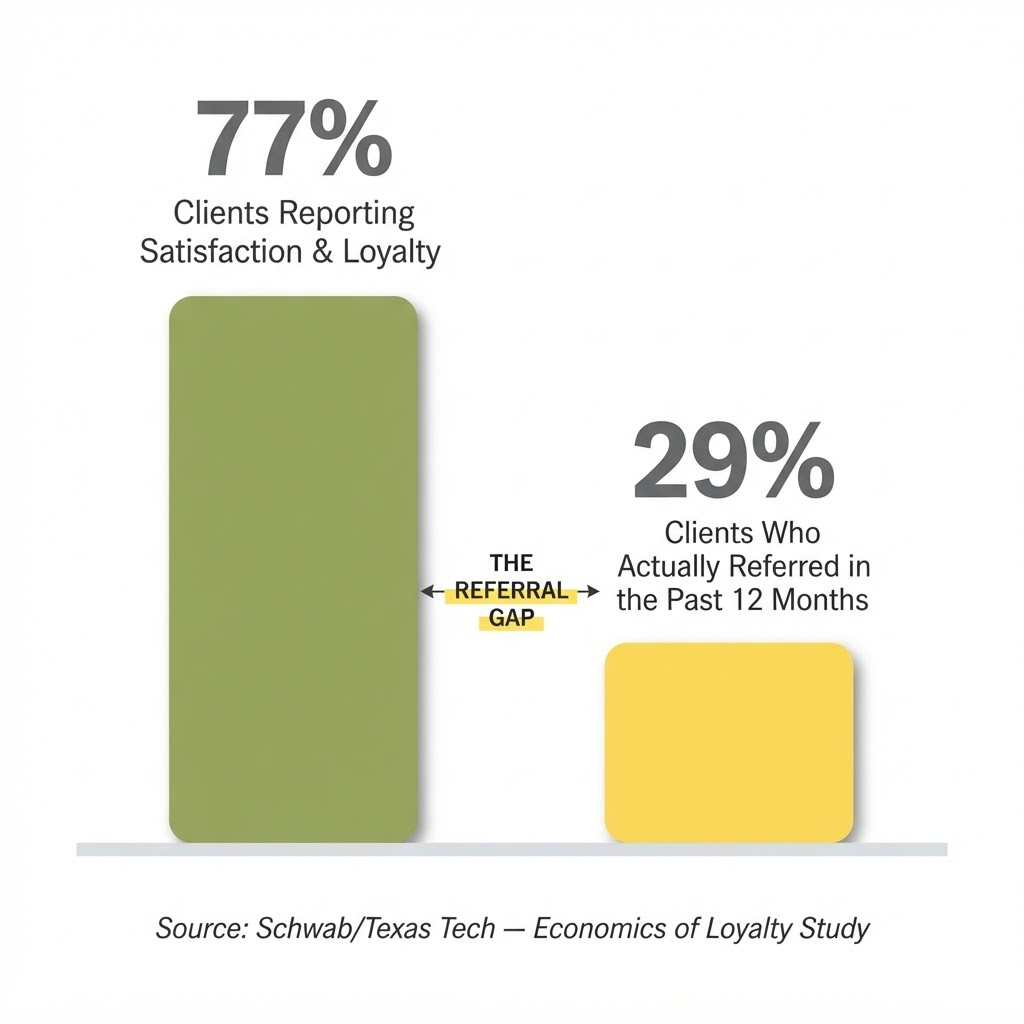
The gap exists because referring someone is a bigger ask than it feels like from the outside. It means putting your own reputation behind a recommendation, in a specific moment, to a specific person, for a specific reason. Being satisfied doesn't manufacture that moment. It just means that if the moment ever arrives, the client won't hesitate. Most businesses never build the moment. They just wait for it.
The referral gap most businesses never investigate
Here's what makes this gap dangerous: it's invisible from the inside. Every internal signal a founder-led business tracks, renewal rate, satisfaction surveys, testimonial requests, support tickets, points toward “things are going well.” None of those metrics were built to catch a missing referral. So the gap sits there, untouched, quarter after quarter, while leadership keeps reading strong retention as proof the relationship side of the business is fully healthy.
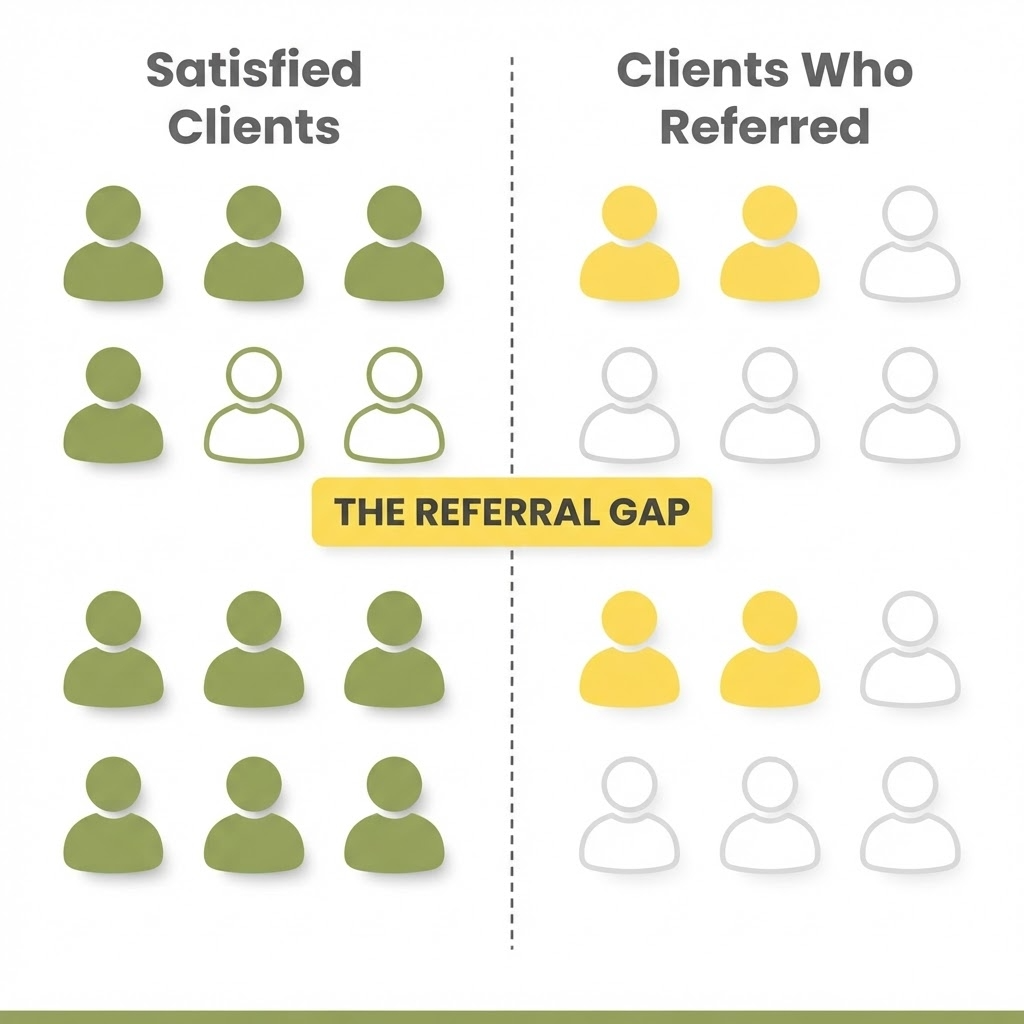
A few patterns tend to explain why your happiest clients never refer:
- No one ever asked. This is the single largest driver in almost every study on the topic. Clients report they'd happily refer if asked directly, but very few businesses build an actual asking moment into the relationship. Gratitude sits there unused because no channel exists for it to become an introduction.
- The client can't articulate what makes you different. A satisfied client who can't describe, in one sentence, what specifically you do that a competitor doesn't, has nothing concrete to say when a friend asks “does anyone know a good [your category]?” Vague satisfaction doesn't translate into a usable recommendation.
- The ask, if it exists, comes at the wrong moment. Referrals asked for at contract signing or during a slow news month land far weaker than referrals asked for right after a visible, specific win, when the result is fresh and easy to describe.
- There's no easy next step for the person being referred. Even a willing client will let a referral die if making the introduction feels like extra work: no simple way to share your info, no clear “who this is for,” nothing to forward.
- Referrals are treated as a hoped-for outcome, not a built process. Most businesses don't have a referral system. They have a referral wish, which shows up occasionally and gets treated as a pleasant surprise rather than something engineered to happen on a schedule.
Each of these produces the same outward symptom: a loyal client base that quietly never grows the pipeline. Each one needs a different fix, and none of them get found by staring at a satisfaction score.

What this looks like from the inside of a founder-led business
In more than 20 years advising founder-led companies on their growth systems, this is one of the more consistent blind spots that shows up during a diagnostic conversation. Leadership can usually name their best, most loyal clients without hesitation. What they can't usually answer, without going and checking, is when those same clients last referred anyone, or whether they've ever been asked to. The two questions feel like they should have the same answer. They almost never do.
Once the gap becomes visible, the instinct is to assume the fix is a bigger ask: a referral bonus, a formal program, an email blast asking everyone at once. Those can help, but they usually underperform because they skip the missing piece: specificity. A generic “know anyone who could use our services?” is easy to ignore. A specific ask, tied to a real result the client just experienced, with a name or type of company already in mind, is far harder to brush past.
How to find your own referral gap this week
You don't need a formal program to start closing this gap. A useful first pass can happen with information you already have:
- Pull your list of clients with the strongest satisfaction signals: highest renewal history, warmest check-in responses, longest tenure. This is your “should be referring” list.
- Cross-reference it against your actual referral source data for the past 12 months, whatever's tracked in your CRM or simply remembered by your team.
- Flag the clients who show up on the first list but not the second. This is the referral gap, made visible instead of assumed.
- For each flagged client, ask one honest question: have we ever actually asked them, specifically, at a good moment? Most of the time, the honest answer is no.
- Pick the three strongest candidates and ask, tied to a specific recent result, not a generic request. “You mentioned the new system saved your team real time this quarter; is there anyone else you know dealing with the same problem?” outperforms “let us know if you know anyone” by a wide margin.
This isn't a one-time list to clear and forget. Treated as a recurring check, tied to renewal conversations or project wrap-ups, it turns an occasional pleasant surprise into a real, repeatable source of pipeline.
Why this matters more than it looks like it should
A quiet client relationship doesn't feel like a problem. It feels like success: no complaints, steady renewals, a comfortable rhythm. That's exactly what makes the referral gap so easy to miss. Nothing about a happy, silent client sets off an alarm. But a growth cycle that depends on delivery quality alone to generate new pipeline, without an actual mechanism for turning satisfaction into introductions, is leaving a real, quantifiable source of low-cost, high-trust leads sitting untouched.
The Growth System Map is a free, 10-minute self-assessment built to show you where your own growth cycle is actually leaking, whether that's positioning, attraction, conversion, or delivery, including whether your best relationships are quietly underperforming as a referral source.

FAQ
About Marketing Monsoon
Marketing Monsoon, LLC is a growth marketing agency and HubSpot Solutions Partner helping founder-led businesses ($3M-$30M) build the growth infrastructure that aligns marketing, sales, and revenue into one working system. Founded by Jayne Burch, Marketing Monsoon uses its proprietary Growth Engine Diagnostic and the Momentum Hub membership to help CEOs move from scattered tactics to a connected system built for sustainable, compounding growth. Learn more at MarketingMonsoon.com.