



Why the growth cycle metaphor matters: Good to Great 20 years later
Short answer: A business flywheel is Jim Collins' term, introduced in Good to Great and expanded in Turning the Flywheel, for how sustainable growth actually happens. Not through one big breakthrough, launch, or hire, but through the same aligned set of actions pushed consistently in the same direction until momentum compounds and growth starts to feel like it's happening almost on its own. It applies to your business as a diagnostic: if your marketing, sales, and delivery efforts aren't compounding, something in the cycle is broken. It's rarely a sign you need a bigger single push.
That's the direct answer. The reason the metaphor is worth revisiting now, more than two decades after Collins first wrote about it, is that most businesses still misread what "momentum" actually requires, and that misread costs them years.
Why a 20-year-old business book is still the right lens
Good to Great was published in 2001. Jim Collins has continued returning to the flywheel concept ever since, including a session at the 2025 CEO Coaching International summit built specifically around why the idea still holds up in a business environment that looks nothing like it did when the book came out (CEO Coaching International, 2025). That's not nostalgia. It's because the core claim was never about a specific industry or era. It was about how momentum works, physically and organizationally, and that mechanism hasn't changed even though the tools around it have.
Collins' original image is simple: imagine a massive, heavy metal disk mounted on an axle. The first push barely moves it. The second push, in the same direction, moves it a little further. There's no single turn that makes the flywheel take off. But if you keep pushing in a consistent direction, turn after turn, the disk eventually builds enough momentum that it starts to carry itself, and each additional push produces more motion than the last.
The reason this metaphor keeps resurfacing in growth conversations is that it directly contradicts how most businesses actually try to grow: a new campaign here, a rebrand there, a different agency next quarter, each one treated as its own fresh start instead of another turn of the same wheel. Every restart resets the flywheel back to a near-standstill. That's the expensive part.
The four turns of a real growth flywheel
Collins' framework is intentionally simple: a small number of connected components, each one making the next one easier, looping back on itself. Applied to a founder-led business's growth system, that loop typically has four turns:
- Offer: What you're actually promising the market, and whether it's specific enough for someone to repeat back accurately.
- Attract: Getting the right audience, not just more traffic, in front of that offer consistently.
- Convert: Turning attention into a closed deal through a sales process the team can actually execute the same way every time.
- Deliver: Making good on what was sold, in a way that produces a result worth referring.
Each turn only compounds if the one before it is solid. A stronger offer makes attraction easier. Better-fit attraction makes conversion easier. A cleaner conversion process makes delivery easier. And strong delivery is what feeds the next turn: referrals, repeat business, and case studies that make the next offer even easier to sell. That last connection, delivery back into offer, is exactly what makes it a wheel and not a funnel. A funnel ends. A flywheel feeds itself.
This is also why "system problem" language matters more than "marketing problem" language in this framework. A weak offer isn't a marketing failure. Neither is a broken handoff between sales and delivery. Both are breaks in the same loop, and both stop the flywheel from compounding regardless of how hard any single turn gets pushed.
What stops a flywheel from turning
Most businesses don't lack effort. They lack a wheel that holds the effort. A few patterns show up constantly in growth systems that aren't compounding:
- Every push starts a new wheel instead of turning the existing one. A new campaign, a new hire, a new tool, each treated as a fresh start rather than another turn in the same direction.
- One turn is strong and the others are weak. Great at attracting attention, inconsistent at converting it. Great at closing deals, inconsistent at delivering a result worth referring.
- The loop doesn't actually close. Delivery happens, but nothing routes that success back into the offer or the next round of attraction, so the flywheel effect never kicks in even though the individual pieces work.
- Leadership expects flywheel-level results from first-push effort. The heaviest lift is always the first few turns. Expecting late-stage acceleration from an early-stage push is a near-guaranteed way to conclude, wrongly, that "this isn't working" and restart the whole thing.

What it looks like when the wheel actually turns
The flywheel effect is easiest to see in hindsight, which is exactly why it gets underestimated while it's happening. One Marketing Monsoon client, a solar company, is a clean example. The marketing wasn't the missing piece: it was generating real interest from the start. What was missing was the rest of the loop. Once the sales process, the CRM, and the handoff between marketing and sales were built into a system that reliably converted and delivered on what marketing produced, the same lead volume that had been underperforming for months began compounding. Close rate increased 5x, and revenue grew from roughly $500,000 to $1 million within nine months, without a proportional increase in marketing spend.
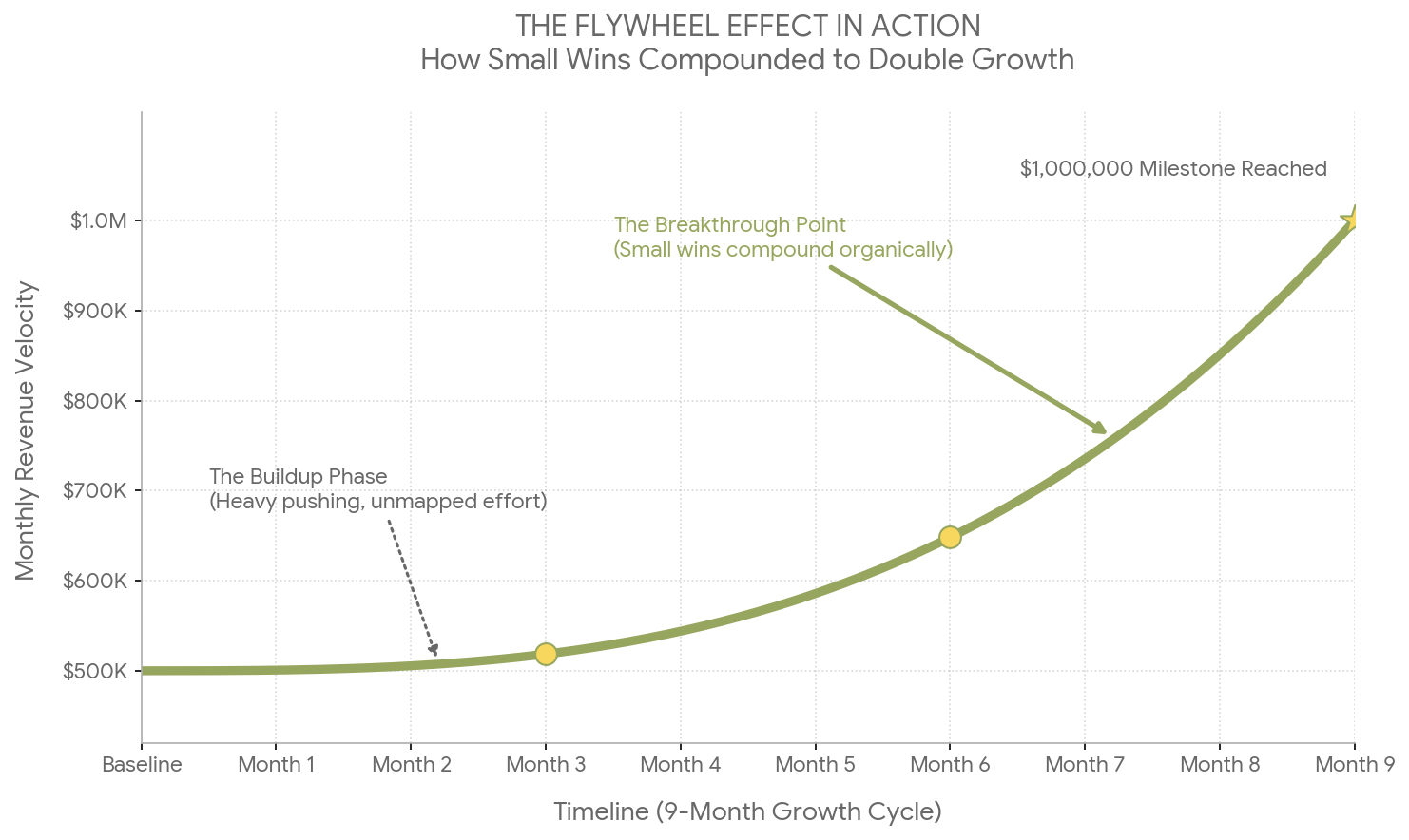
None of that happened on the first turn. It happened because each fixed piece of the system made the next piece work better, which is the entire mechanism Collins described two decades ago. The lesson isn't "fix your CRM." It's that growth compounds when the turns connect, and it stalls when any one of them is missing, no matter how hard the others are pushed.
Why this reframes how you should think about "momentum"
Most founders use the word momentum loosely, usually to describe a good month or a strong campaign result. Collins' flywheel gives it a much more specific and more useful definition: momentum is what happens when this quarter's push makes next quarter's push easier, because the system connecting them is intact. A great month that doesn't make the following month easier isn't momentum. It's a spike.
That distinction is the practical value of the metaphor. It gives you a concrete question to ask about any growth initiative before you invest in it: does this make the next turn of the wheel easier, or does it stand alone? If the honest answer is "stand alone," it might still be worth doing, but it won't compound, and it shouldn't be evaluated as if it will.
It also reframes how leadership should read a slow quarter. In a funnel mindset, a flat quarter looks like proof the current approach isn't working, which is exactly the moment most businesses swap agencies, rebrand, or launch something new. In a flywheel mindset, a flat quarter is only meaningful in the context of what came before it: was this quarter's push connected to last quarter's, building on work already in motion, or was it another isolated restart? Two businesses can post identical quarterly numbers and be in completely different positions, one nearing the point where the wheel starts carrying itself, the other back at a standstill because the previous turn never connected to this one.
Where to look first if your flywheel feels stuck
If growth has plateaued despite real effort, the highest-leverage move usually isn't pushing harder on the turn that feels most familiar (for most founders, that's attraction: more content, more ads, more outreach). It's identifying which of the four turns is actually the weak link, because that's the one quietly capping the other three.
The Growth System Map is a free, 10-minute self-assessment built to show you exactly that: which turn in your growth cycle, offer, attract, convert, or deliver, is holding the rest of the wheel back, before you spend another dollar pushing on the wrong one.

FAQ
About Marketing Monsoon: Marketing Monsoon, LLC is a growth marketing agency and HubSpot Solutions Partner helping founder-led businesses ($3M-$30M) build the growth infrastructure that aligns marketing, sales, and revenue into one working system. Founded by Jayne Burch, Marketing Monsoon uses its proprietary Growth Engine Diagnostic and the Momentum Hub membership to help CEOs move from scattered tactics to a connected system built for sustainable, compounding growth. Learn more at marketingmonsoon.com.